Monday, 13 July 2015

The Difference between Analogue and Digital Antennas

Ready to go digital ?
With the advent of digital television, much has been hyped about the multiple new services being offered, as well as the increase in picture quality and audio quality as well as interactive services and multiple channels. But whilst many people can enjoy all of these services, some people still have an old analogue style antenna that they need to upgrade. This article will talk about the advantages and disadvantages of both analogue and digital antennas.

Analogue antennas have been around for a very long time, with the popular type of Yagi antenna being around for well over 60 years. This type of antenna was made to pick up analogue signals to their best ability, as well as minimising on ghosting of the image and repeating of the image from various different sources.

Tuned To Receive Set Frequency Bands


Tune Frequency band

Many of these antennas are tuned to receive a particular frequency band for receiving television signals, as well as some antennas which are capable of receiving radio signals. Analogue antennas were built without the future of digital television in mind, therefore much of the technology that goes into the broadcast of digital terrestrial television signals can cause issues.

Many analogue antennas are just simply too old to function properly as a high gain antenna, ready for receiving digital signals. In many cases, the type of cable coming from the antenna into the home is also too old and will need to be upgrading to fix reception issues coming from the installed system.

Say Goodbye to Poor Reception Issues


time to say goodbye

If you are suffering from poor reception and connection issues, instead of replacing your old copper cable and analogue antenna system with a new one, why not upgrade to the state of the art digital antenna and cabling system that will get you ready for the digital signals now being broadcast.

Not only are digital antennas tuned for the correct frequencies that digital terrestrial television is broadcast on, but they also offer a number of newer advantages over their analogue counterparts. High band antennas have been specially constructed to offer the best possible signal to noise ratio compared with analogue antennas, and help reduce signal interference, multiplex doubling and other digital signal issues.

Overcome Signal Issues and Poor Reception


overcoming

The latest wide band antennas are for use in areas where the digital signal is split into two overlapping zones. This is where two broadcast tower signals overlap and are broadcasting the same channel multiplexes but at different frequencies. What you will see in your channel list is a doubling of channels, as well as some channels possibly not appearing at all.

In these instances you will need a wide band antenna that is specially designed to cope with multiple signals and getting different channel multiplexes from other sources. In most cases you can block out a certain broadcast tower and focus on the closer one to give you a great signal level.

Check Your Signal Noise Level and Signal Quality Simply


check your signal

The ability of digital set top boxes to help you see the noise level and signal quality on each box is a great feature that was simply missing from analogue systems. With a new digital antenna you can enjoy the latest television in high definition and stereo sound, unlike the previous set of analogue broadcasts.

Because a digital channel can be compressed into a smaller size, more television channels and radio stations can be fit into a single analogue channel. This is what is known as a multiplex.

The digital terrestrial television service is made up of many different multiplexes that contain several television stations, radio stations and interactive services and other information such as MHEG data.

Digital Television Is Here To Stay


digital television

In this sense, analogue television is well and truly dead, and the future of digital television looks bright. With the addition of interactive services to the digital television platform, the need for upgrading your analogue antenna for a brand new, high gain high signal quality digital antenna is great.

Consult your local antenna specialist for more information about how the installation process is carried out, and how you can benefit from a new digital antenna in your area.

Sunday, 14 June 2015

Get the Best Audio from Your Home Theatre Installation

When purchasing a new home theatre to enjoy blockbuster movies on the smaller screen, a lot of people do not take into account the importance of having a high quality audio system to compliment the video. In the past, you could only enjoy the built-in sound coming from your television set, or by hooking up a cheap stereo hi-fi to your television that allowed the audio to be channeled through it.

Best Audio
But today, the market is awash with state of the art, multi-channel surround sound that will make or break your home theatre installation, and this is why:

There are many different types of audio products on the market to take your home theatre to the next level. These include various speaker systems to amplify the music and dialogue of your films, television and video games for deeper bass response and truer sounding vocal replication.

Entry-Level Systems and Connectivity


Many audio systems employ a series of cables to connect to your television, or DVD or Blu-Ray player to divert the audio going to your television instead to a set of speakers for better sound quality.

two stereo speakers
On the entry-level scale of home audio as part of a home entertainment system or home cinema is the basic two speaker system. This system simply replicates the two stereo speakers in your television and replaces them with higher quality speaker units designed to give more bass and treble to whatever you are watching or listening.

Entry-Level Audio Systems


Many people use a micro hi-fi system in this way to boost their experience, and with the added CD player and MP3 or Bluetooth input, you can add very usable functions to your home entertainment system. Just simply connect the two RCA output cables of your television, cable box or games console to the input RCA sockets on the system and switch the mode to accept the audio, making it simple, cheap and effective in smaller rooms.

2.1 audio system
The next tier in the home entertainment audio is with a basic entry-level 2.1 audio system. Much like the micro hi-fi idea, a 2.1 audio system is made up of 2 regular full-range speakers and a single sub-woofer. Unlike the two stereo full-range speakers, the sub-woofer specialises in producing deep bass sounds coming from your music, television or video games.

In many cases, you may see “virtual surround” or “virtualsurround sound” written in the features of these units. In these cases, the system is not a full surround sound system, but there are certain algorithms and effects added to the audio as it exists the speakers to give the effect that the sound is all around you within a room. Sometimes this effect works well, especially with spoken audio in a film, but in most cases, music is affected negatively.

What Is Surround Sound?


Surround sound is a way of feeding single tracks or channels of audio into individual speakers to give the effect that you are “in the room” when there is audio being played from the speakers. A series of speakers are positioned around a room and are facing the listener, and when for instance a rear left speaker plays a dog barking, the listener has the immersive effect of hearing a dog barking behind them. When this audio system is teamed up with a film, different audio tracks are sent to different speakers, in relation to what is being shown on the film and will allow a fully immersive audio experience.

Surround Sound
There are a number of different standards of surround sound, some of which you may have heard of before. Features such as Dolby surround sound, 5.1 surround sound and 7.1 surround sound appear the most popular. In each of these cases a different technology is used to convert the audio signals from a media device such as a television or Blu-Ray player into audio that corresponds to a particular speaker, or mix of speakers.

What Is 5.1 Surround Sound?


The term 5.1 surround sound systems refers to a system of 6 speakers in total, which include four full-range speakers, a central speaker and a sub-woofer. In a 5.1 system, you generally have two front speakers, two rear speakers, a central speaker and the sub-woofer. These are marked so that the listener knows where to place each speaker.

5.1 Surround Sound
They are generally hooked up to a separate surround sound decoder and amplifier, which takes information from the audio tracks of a Blu-Ray DVD, games console or television broadcast, converts these tracks to individual channels and then feeds each individual speaker.

5.1 surround sound has become one of the most popular systems to date, with tens of millions being sold around the world, and has increased the popularity of including the information on television broadcasts, all new films as well as games consoles and even home computers.

What Is 7.1 Surround Sound?


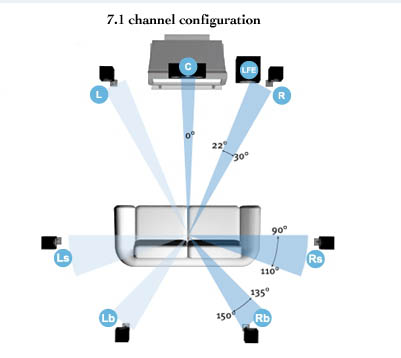
Much like the previous example of 5.1 surround sound, 7.1 surround sound systems employ extra speakers to provide even more depth of audio, with two left and right central speakers to add another dimension. The system still works on the same basis of decoding the signals, and an external decoder or amplifier is necessary unless a television or set top box already has outputs for all of the speakers.

7.1 Surround Sound

A 5.1 surround sound system can easily be upgraded via the purchase of two extra side speakers and a 7.1 decoder/amplifier. This ability to upgrade is a great way of ensuring that you can keep the speakers that you know and love, as well as having a new sounding and bigger sounding experience to enjoy your films, media, music and video games.

Similar to a 5.1 system, 7.1 surround sound comes in a huge variety of designs and accessories to choose from and there is an added level of customisation to each room as many systems allow the use of fine local tuning of speakers to allow the system to work in optimum conditions in a less than optimum room.

The Emergence of 10.2 Surround Sound Systems


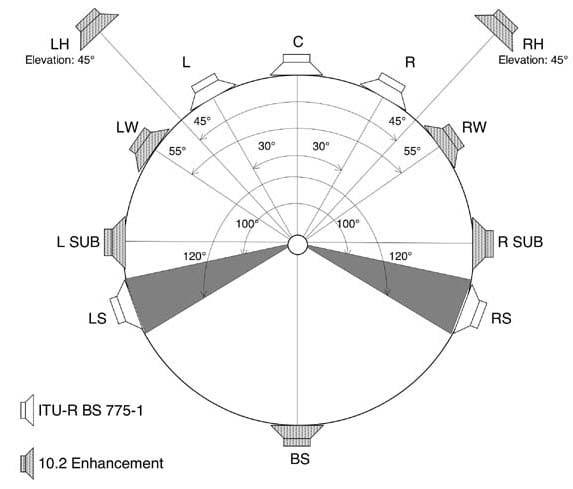
Relatively new to the market has been the introduction of a 10.2 surround sound system. This new system includes 12 speakers and adds to the immersive effect that the previous systems bring with it. The extra speakers provide a more in-depth audio that allows extra single channels to be listened to, along with a mixing function depending on the media being played.

 10.2 Surround Sound Systems

Film producers and television broadcasters decide which the best mix of audio channels is and which channels of audio they should be fed into.

In this way, the viewer gets a better sense of what is happened on screen via the speakers and immersive sound and allows the viewer to see and hear the film or broadcast exactly how the director intended, creating a truly stunning experience for the home viewer.

Surround sound systems come in all shapes and sizes and for all budgets, so choose wisely to allow your system to expand in the future. Choose a system that incorporates a known technology such as Blu-Ray into the system to give you more flexibility, allowing you to create a truly immersive home entertainment or home theatre system that comes within your budget.